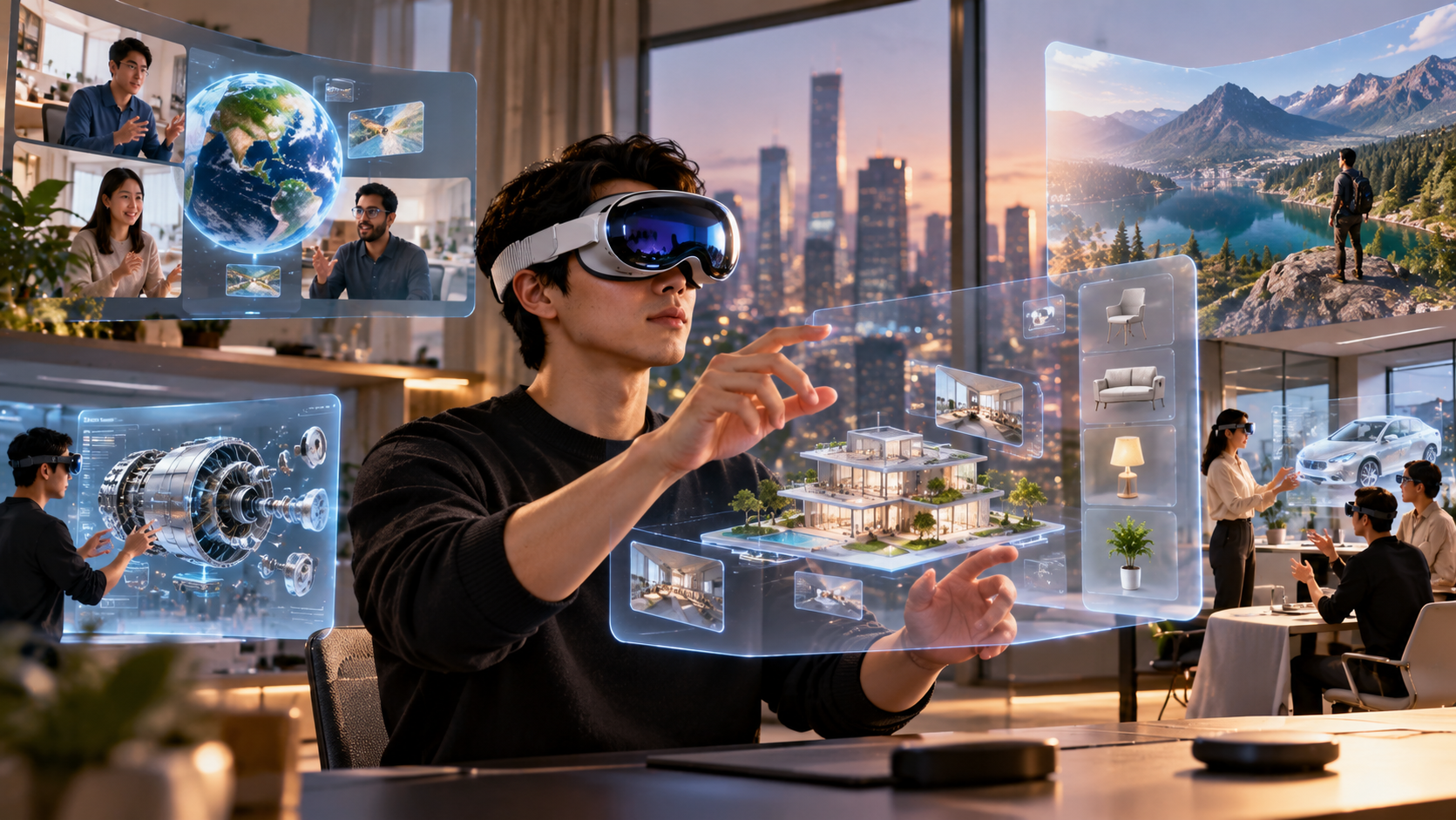
Spatial computing remains a relatively specialized consumer category, but some of its most practical applications may emerge first inside businesses rather than living rooms.
Apple’s Vision Pro and other advanced mixed-reality systems allow digital information to be positioned within a user’s physical environment. Instead of viewing a three-dimensional model on a conventional monitor, an engineer can potentially examine it at realistic scale and move around it naturally.
That capability creates interesting possibilities in fields where three-dimensional understanding is economically valuable.
Engineering teams can inspect complex CAD models before physical prototypes are manufactured. Medical organizations can explore anatomical visualizations and simulation environments. Aviation and industrial companies can use immersive systems for training where mistakes in the real world would be dangerous or expensive.
Enterprises also have a different economic calculation from ordinary consumers.
A headset costing several thousand dollars may appear expensive for entertainment. But if the same device reduces engineering errors, avoids physical prototypes or improves specialist training, the return on investment can look very different.
Significant obstacles remain. Headsets need to become lighter, less expensive and more comfortable for extended use. Developers also need compelling applications that cannot be reproduced adequately on conventional computers.
Spatial computing therefore may follow a different adoption path from smartphones.
Rather than immediately becoming a mass-market consumer product, immersive computing could establish itself within specialized professional environments first.
If enterprise adoption supports continued improvements in displays, processors, batteries and manufacturing scale, those advances could eventually reduce costs for broader markets.
The important question is therefore not simply whether everyone will soon wear a headset. It is whether spatial interfaces become indispensable tools in industries where working in three dimensions provides measurable value.