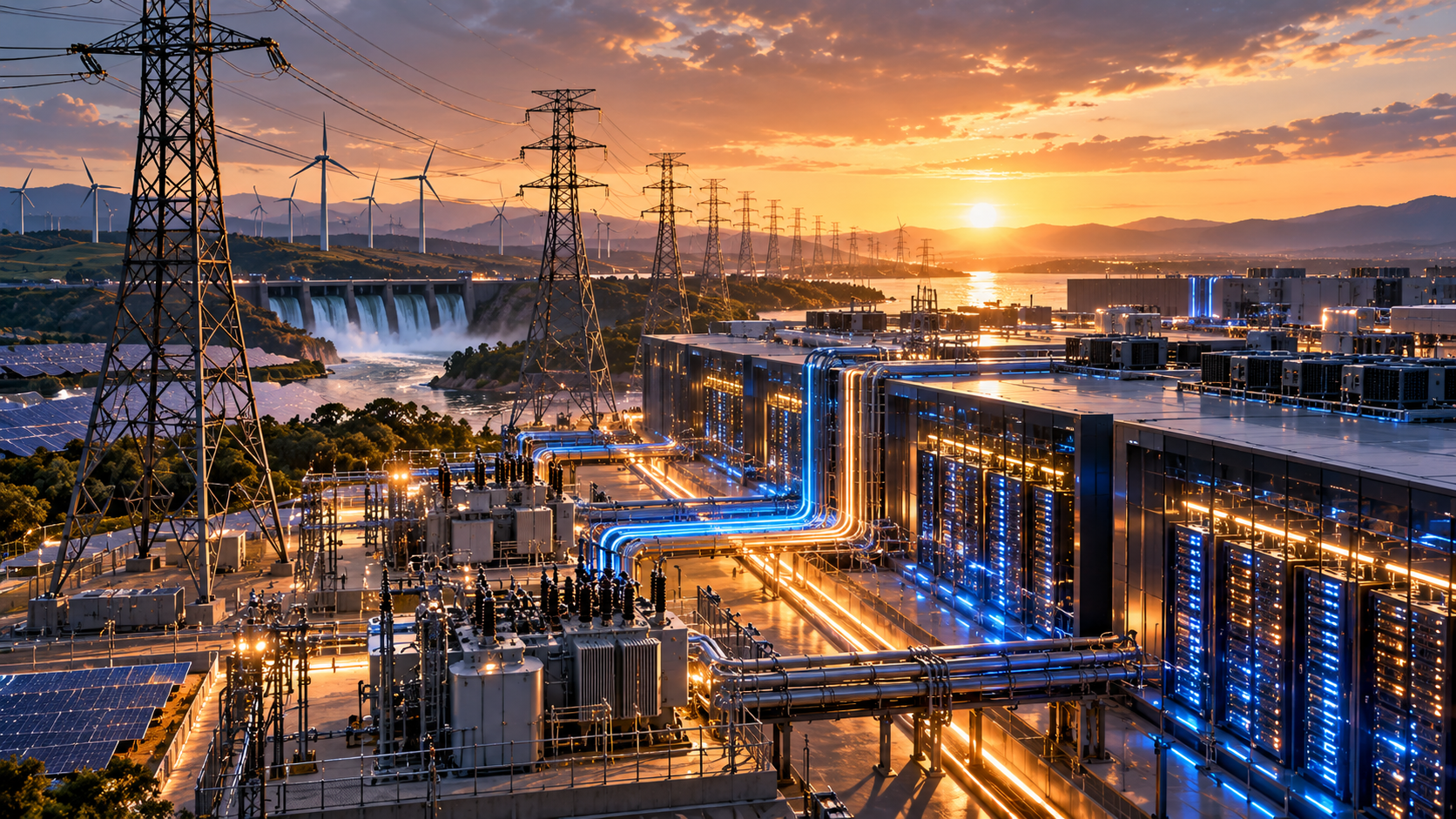
Artificial intelligence is creating an infrastructure challenge that extends far beyond semiconductors and data centers. As technology companies build increasingly powerful AI training clusters, the enormous amount of electricity required to operate them is placing new pressure on power grids.
Training and operating advanced AI models requires thousands of high-performance processors running simultaneously. Those processors also generate substantial heat, creating additional electricity demand for cooling systems. As AI infrastructure expands, finding suitable land and buying GPUs are therefore only part of the equation. Developers also need reliable access to enormous quantities of electricity.
This is pushing major technology companies—including Microsoft, Google and Amazon—into areas traditionally associated with utilities and energy companies. Technology firms have pursued long-term renewable-energy agreements and explored nuclear, geothermal and other sources capable of supplying large quantities of relatively consistent electricity.
The bottleneck is increasingly about grid connections, transmission infrastructure and dependable power generation. A new data center cannot simply connect to the grid instantly. Large projects may face lengthy interconnection processes while utilities determine whether existing substations and transmission networks can support the additional load.
This changes the competitive landscape surrounding AI. Semiconductor design will remain critical, but access to reliable energy could increasingly determine where large computing clusters can actually be built.
The next phase of AI infrastructure may therefore depend as much on electrical engineers, utility companies, power developers and grid planners as it does on machine-learning researchers. Computational capacity is becoming inseparable from energy capacity.