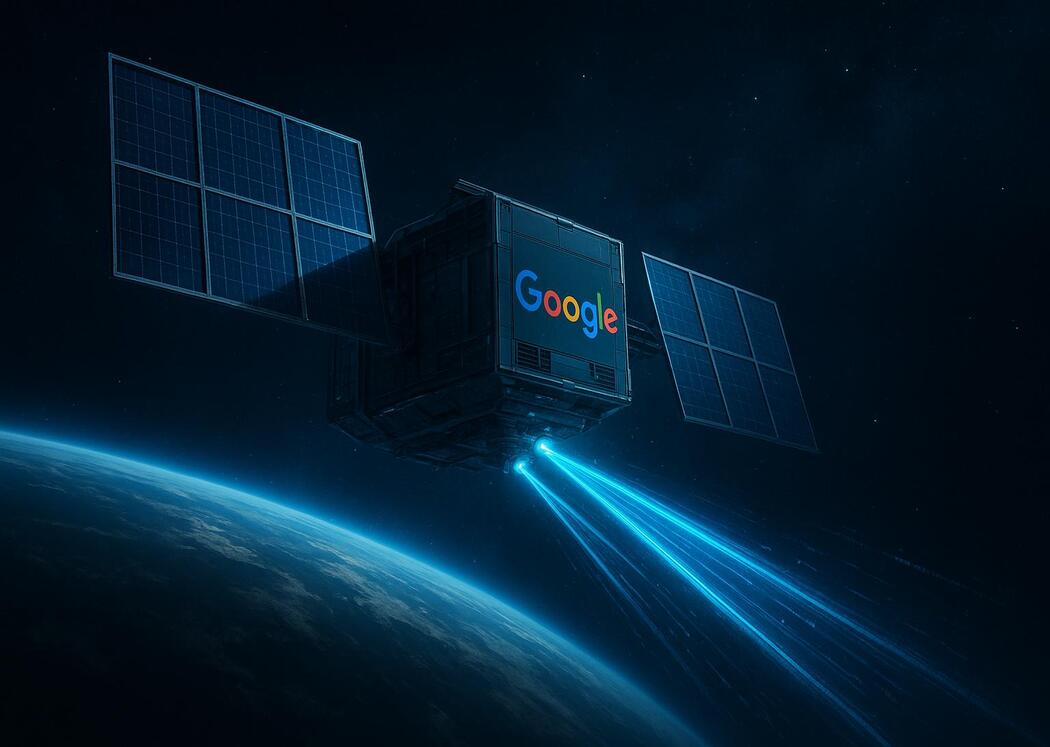
Google is preparing to test an unusual answer to AI’s growing infrastructure demands: move some of the computing hardware off the planet.
Through Project Suncatcher, Google is researching whether machine-learning infrastructure could eventually operate in space using networks of solar-powered satellites equipped with its Tensor Processing Units.
The concept takes advantage of one enormous resource available in orbit: sunlight.
Google says satellites in low Earth orbit could potentially access considerably more solar energy than equivalent installations on Earth. In theory, that could provide an abundant source of power for future computing infrastructure.
The project is now moving from theoretical research toward orbital testing.
Google says a prototype mission is scheduled to test how its TPU hardware performs in space. Earlier plans described two prototype satellites targeted for early 2027, while the company’s September 2026 update says the project is preparing for its first orbital test.
This should not be confused with Google preparing to deploy a functioning orbital AI data center immediately.
Enormous engineering problems remain, including radiation exposure, heat management, launch costs, maintenance and extremely high-bandwidth communication between satellites.
But the project illustrates how extreme AI infrastructure requirements are pushing technology companies to reconsider assumptions about where computing must happen.
Data centers have traditionally been built near electricity, fiber connections and users. If orbital computing eventually becomes practical, the geography of computing could expand dramatically.
For now, Project Suncatcher remains a research moonshot—but one that is about to face a real test in space.