Alibaba is intensifying China’s effort to build a more self-sufficient artificial-intelligence technology stack.
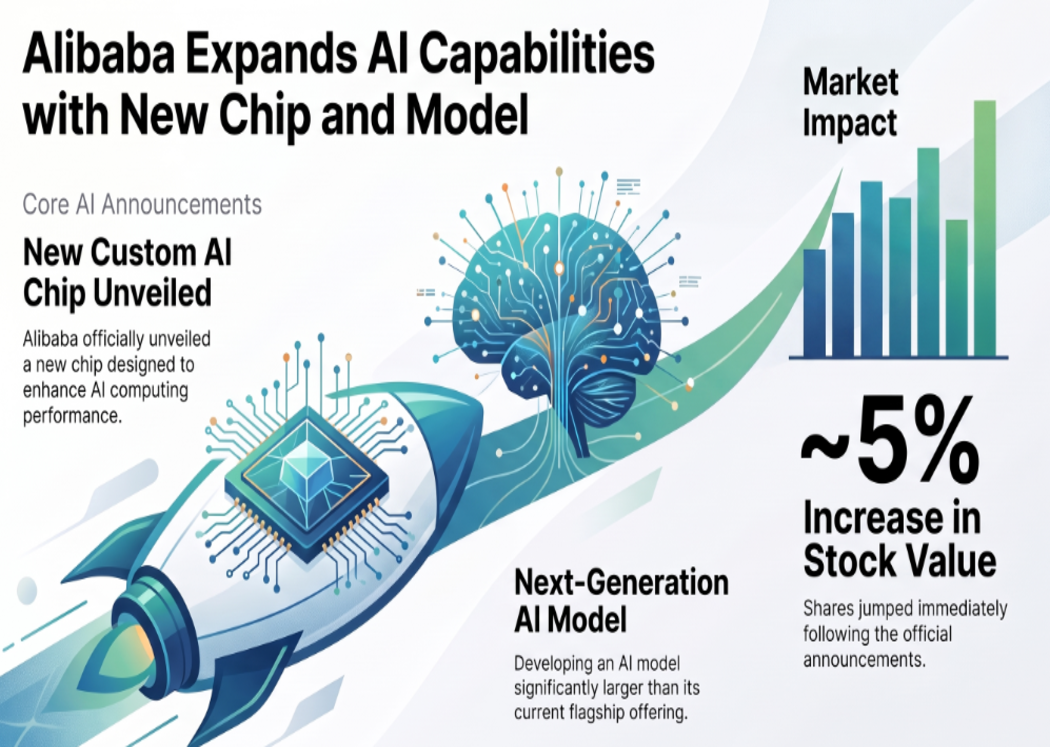
At its Apsara conference in Hangzhou, the company announced a next-generation AI chip and said it was developing an AI model potentially up to four times larger than its existing flagship model. Alibaba described the new processor as China’s most powerful AI chip, while its Hong Kong-listed shares rose roughly 5% following the announcements.
The significance goes beyond one semiconductor.
Alibaba is attempting to compete across multiple layers of AI infrastructure simultaneously: foundation models, cloud computing, data centers and processors.
That vertical strategy has become increasingly important as U.S. restrictions complicate Chinese access to Nvidia’s most advanced AI hardware.
Chinese technology companies therefore have a strong incentive to develop domestic alternatives.
For Alibaba, the strategy also connects directly to its cloud business. Building both AI models and the infrastructure required to run them allows the company to offer customers a more integrated platform rather than relying entirely on imported accelerators.
The challenge is enormous.
Nvidia benefits from years of software development around CUDA as well as a sophisticated ecosystem spanning processors, networking and AI libraries. Matching raw chip specifications is therefore only one part of creating a competitive AI platform.
Nevertheless, Alibaba’s announcement demonstrates that China’s AI competition is moving deeper into the technology stack.
The race is no longer simply about who can build the best chatbot. Increasingly, it is about who can control the chips, models, cloud infrastructure and software required to operate AI at enormous scale.