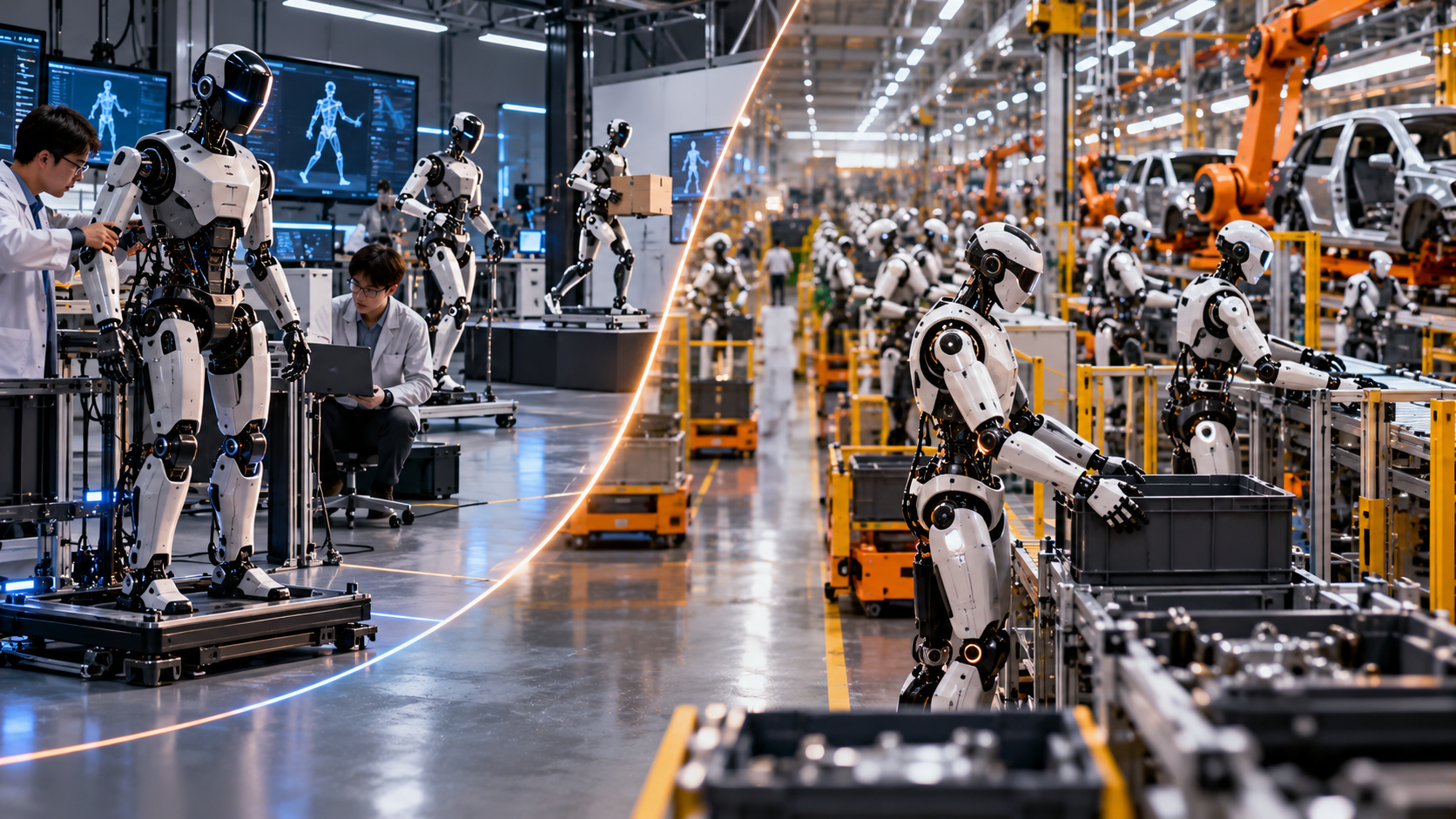
Humanoid robots are gradually moving from carefully controlled demonstrations toward real industrial experiments.
Companies including Figure AI, Tesla and Boston Dynamics are developing increasingly sophisticated robots designed to operate in environments originally built for humans. Automotive manufacturers, logistics operators and industrial companies have been testing humanoid systems for tasks involving material movement, component handling and repetitive factory work.
The humanoid form has an obvious advantage: our infrastructure is already designed around the human body.
Factories contain stairs, doors, shelves, workstations, carts and tools positioned for human workers. Instead of redesigning an entire facility around specialized machinery, a sufficiently capable humanoid robot could theoretically operate within existing spaces.
However, building the physical machine is only half of the challenge.
Motors, actuators, cameras, batteries and mechanical components are steadily improving, but robots must also understand unpredictable physical environments. A box might appear in a different location. An object may be rotated. A worker could suddenly cross the robot’s path.
This is why the emerging competitive battleground is increasingly physical intelligence.
Developers are building AI foundation models that allow robots to interpret visual information, understand instructions and translate them into physical actions. The long-term goal is not to manually program every possible movement, but to create machines capable of adapting to situations they have not encountered before.
Significant challenges remain around reliability, safety, battery life and economics. But if general-purpose robotic intelligence improves sufficiently, humanoid robots could eventually become a new category of industrial infrastructure.