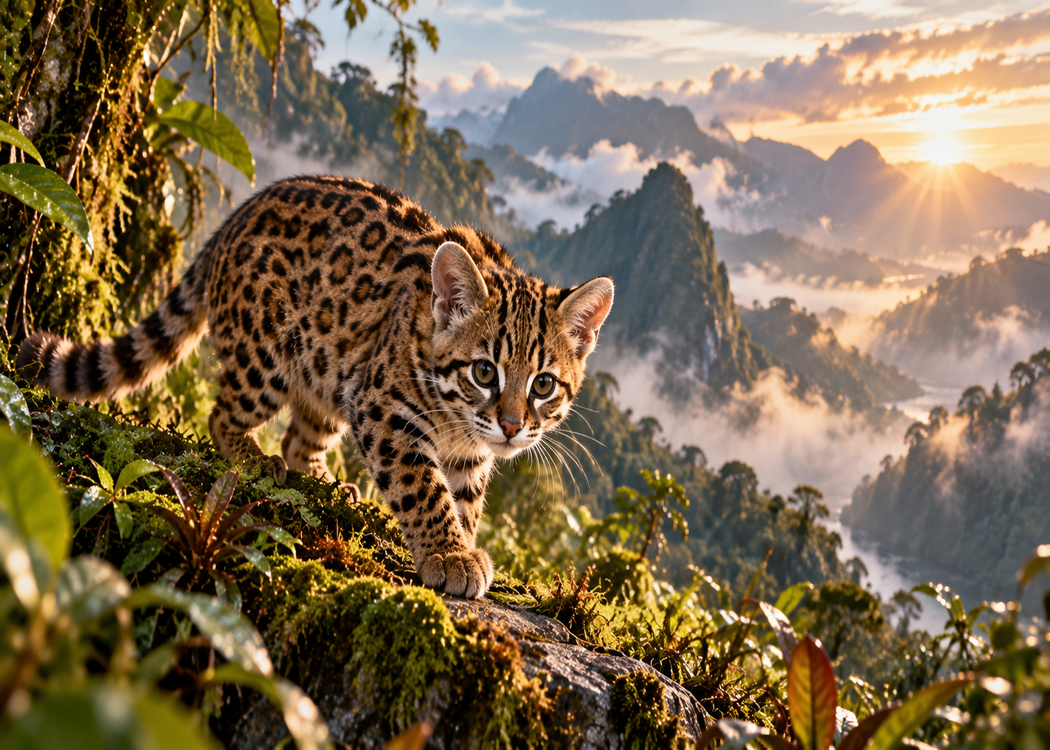
Genetic research identifies Leopardus tilcayo as a distinct species, revealing previously unrecognized diversity among South America’s small spotted cats.
Scientists have described a new species of small wild cat from Bolivia’s Yungas cloud forests, adding a distinctive branch to the feline family tree.
Named Leopardus tilcayo, the spotted animal is smaller than an average domestic cat. Its identification forms part of a study published in Current Biology that concludes South America’s tiger cats comprise five genetically distinct species.
In its September 21 briefing, Nature described the tilcayo as the first new cat species formally described by science in more than a century. The milestone concerns its scientific description: local communities already knew the animal and used the name “tilcayo,” which the researchers retained.
The investigation brought together genetic evidence from living animals and historical museum specimens. Researchers analysed 38 complete genomes from members of the genus Leopardus, allowing them to distinguish evolutionary lineages that can be difficult to separate by appearance alone.
Their results indicate that the tilcayo lineage diverged from the lineage containing Leopardus tigrinus and Leopardus pardinoides approximately 1.4 million years ago. That finding places its evolutionary history far beyond the recent moment when scientists formally recognized it.
One animal central to the discovery lives at Bolivia’s Senda Verde wildlife refuge. According to National Geographic’s reporting, a resident originally found it as a kitten and mistook it for a domestic cat. After its wild nature became apparent, it was transferred to the sanctuary, where biologist Paola Nogales-Ascarrunz encountered it in 2017.
The sanctuary animal weighs approximately 1.4 kilograms and has conspicuous, large spotted markings. Its small frame and resemblance to other tiger cats help explain why identifying the population required more than a casual visual comparison. Genomic analysis supplied evidence that it belonged to a distinct species.
Recognition also brings unanswered conservation questions into sharper focus. Scientists do not yet know how many tilcayos remain in the wild. A known animal in protective care should therefore not be mistaken for evidence that only one individual survives.
The broader significance extends beyond naming a cat. When animals previously grouped together are recognized as separate species, conservation assessments must consider their individual distributions, population sizes and threats. A seemingly widespread group can contain distinct populations with much narrower ranges and different protection needs.
For the tilcayo, formal recognition provides a foundation for that work. Surveys and field observations will be needed to establish where it lives, how numerous it is and which habitats are most important to its survival. The discovery shows how genetic research, museum collections and local knowledge can together reveal biodiversity that familiar appearances have concealed.
Sources: