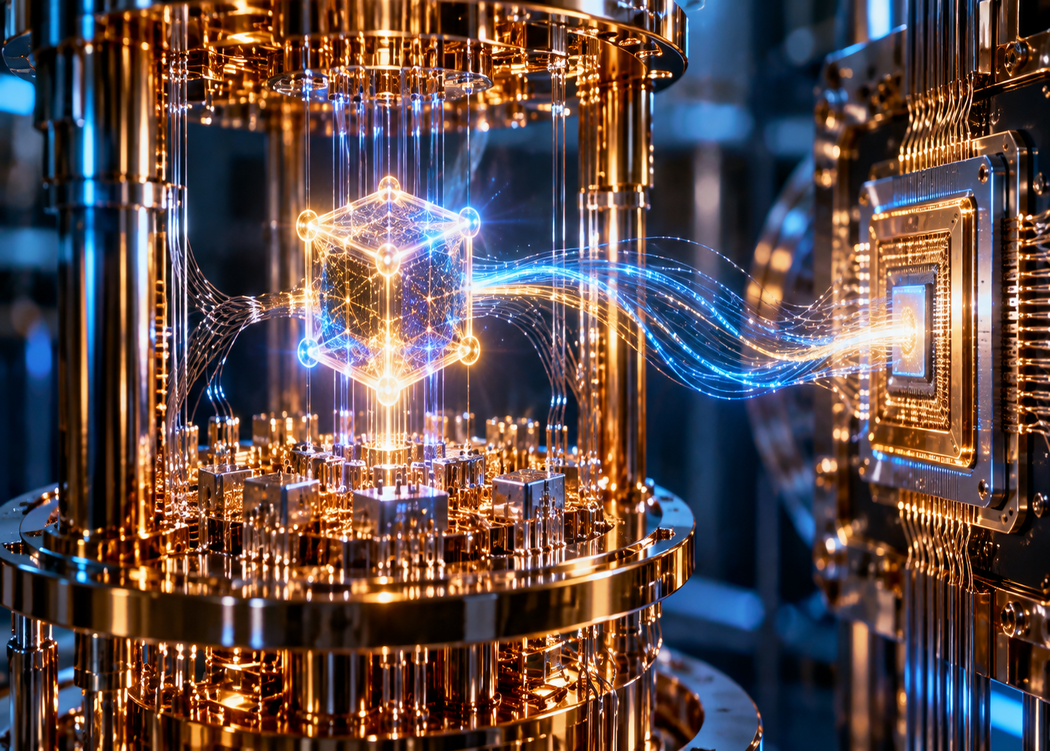
Quantum computing researchers are making progress toward one of the field’s most difficult objectives: building computers that can perform calculations reliably despite the fragile nature of quantum information. Unlike classical computers, which store information in bits representing either zero or one, quantum computers use qubits that can exist in quantum superpositions. This enables new forms of computation but also makes quantum systems extremely sensitive to disturbances and operational errors.
One promising solution is the development of logical qubits, which encode quantum information across multiple physical qubits. Instead of relying on a single vulnerable component, quantum error-correction techniques distribute information so that certain errors can be detected and corrected without destroying the encoded quantum state. Researchers have demonstrated increasingly sophisticated logical-qubit operations, while groups including Microsoft and QuTech have pursued topological approaches intended to make quantum information more robust.
Topological quantum computing is especially attractive because it aims to protect information through physical properties that are less sensitive to certain local disturbances. However, demonstrating a logical qubit, demonstrating topological hardware and achieving fully fault-tolerant quantum computation are distinct milestones. A reliable, large-scale fault-tolerant quantum computer has not yet been established by the research described here.
Continued progress in error correction could eventually make quantum computers capable of running calculations that are currently impractical on conventional machines. Potential applications include simulating complex molecules, investigating new materials and studying quantum physical systems. The immediate achievement is not that quantum computers have become error-free, but that researchers are learning how to control and correct the errors that have limited their development.
Sources: