Artificial intelligence may eventually transform medicine in a place that receives far less public attention than AI chatbots: the scientific laboratory.
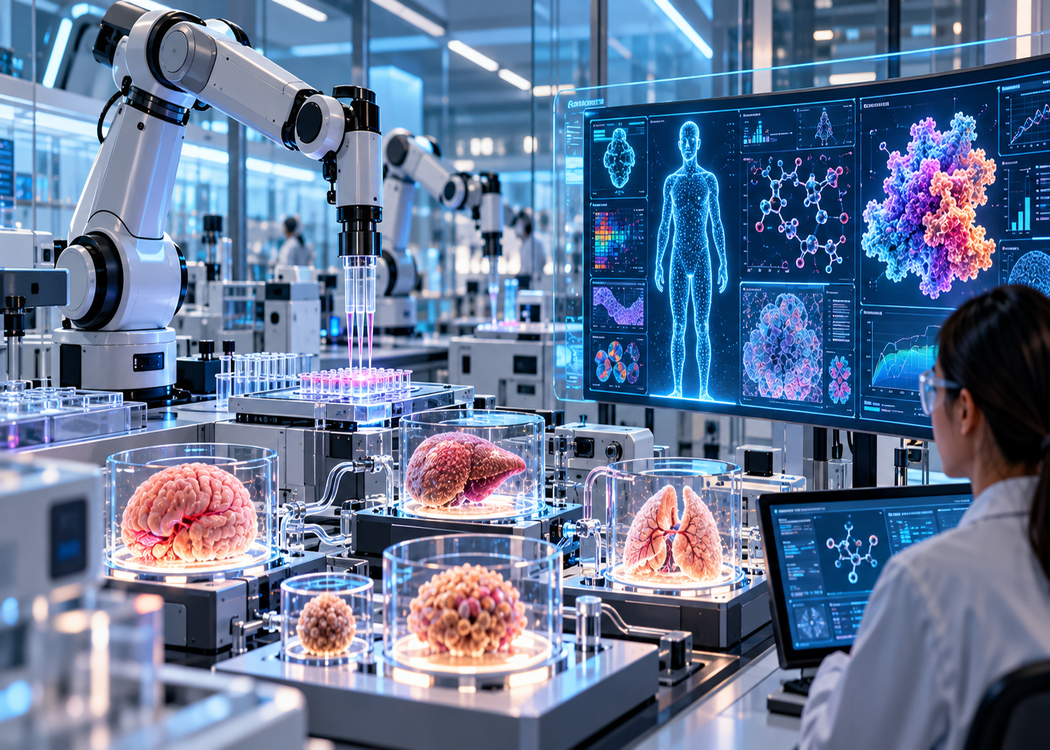
Roche has outlined plans to move pharmaceutical research toward increasingly autonomous AI-driven laboratories. These systems would combine artificial intelligence, robotics and sophisticated laboratory automation.
Traditional drug discovery involves repeated cycles. Scientists develop a hypothesis, design an experiment, prepare samples, conduct tests, analyze the results and then decide what experiment should happen next.
An autonomous laboratory could increasingly connect these stages.
Robotic systems might prepare and test thousands of biological samples while AI models analyze the incoming data, identify promising results and recommend the next experiments. Over time, researchers hope parts of this cycle could operate continuously with significantly less manual intervention.
NIH is investing in related infrastructure involving human organoids, robotics, artificial intelligence and advanced data systems.
This does not mean scientists are about to disappear from pharmaceutical laboratories. Human researchers remain essential for establishing research objectives, interpreting unexpected findings, ensuring safety and determining whether conclusions are scientifically meaningful.
Instead, automation could remove some repetitive experimental work while dramatically increasing the number of hypotheses researchers can test.
The potential impact is significant. Developing a successful medicine can currently require many years of research and enormous financial investment, with most experimental candidates ultimately failing.
If AI-powered laboratories can identify failures earlier, optimize experiments more efficiently and uncover promising drug candidates faster, artificial intelligence could influence medicine long before a new treatment ever reaches a patient.