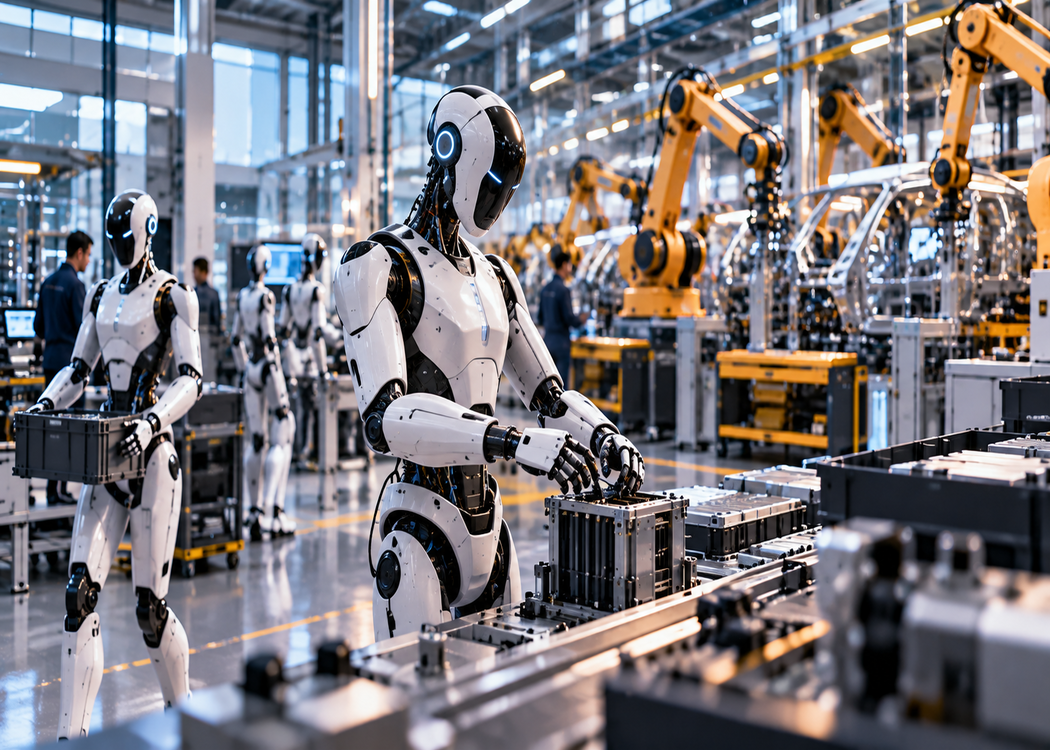
Around 7,000 humanoids were sold for industrial and professional-service applications in 2025, highlighting the distance between demonstrations and widespread deployment.
Humanoid robots are attracting attention with demonstrations of increasingly sophisticated movement and manipulation. Their commercial footprint, however, remains small compared with established forms of automation.
Approximately 7,000 humanoid robots were sold worldwide in 2025 for industrial and professional-service applications, according to International Federation of Robotics data reported by Reuters. Many were purchased for research and to generate AI training data, rather than to perform routine productive work.
That distinction matters. A robot delivered to a research laboratory contributes to technology development, but its sale does not demonstrate that a factory or service business has successfully automated a recurring task. Sales figures capture demand for hardware across different stages of development and use.
The tally also has defined boundaries. Based on supplier and national industry association data, it excludes consumer and military humanoids, while medical robots are classified separately. It should therefore be understood as a measure of particular commercial categories, rather than every humanlike robot sold globally.
The contrast with conventional industrial robotics is substantial. The federation’s World Robotics 2026 release reported more than 600,000 new industrial robot installations in 2025, bringing the worldwide operational stock to approximately five million. Annual installations increased 11%, while the installed base grew 9%.
Humanoid sales and industrial robot installations are different measures covering different applications. Even with that limitation, the figures show how early humanoids remain in their commercial development.
There is a practical argument for their design. Workplaces, tools and access routes are frequently arranged around human bodies. The federation says a robot with humanlike movement and proportions could have advantages in those environments, particularly if it can perform several tasks. Advances in AI and learning from demonstrations are helping researchers explore that possibility.
The business question is whether that flexibility translates into dependable, affordable work. A successful demonstration shows a capability under particular conditions. An employer must also consider how consistently the machine performs, how much supervision it requires and what happens when conditions change.
Maintenance, downtime and integration costs influence that calculation alongside the purchase price. A robot’s commercial value ultimately depends on the work it completes over time.
Research purchases are therefore meaningful, but they are an early indicator. They help developers collect experience and improve systems; they do not establish broad workplace adoption.
The next evidence to watch is sustained use: robots completing useful tasks across full shifts, customers expanding deployments and repeat orders supported by measurable results. Those developments would show that the capabilities attracting attention online are becoming reliable tools in everyday operations.
Sources: