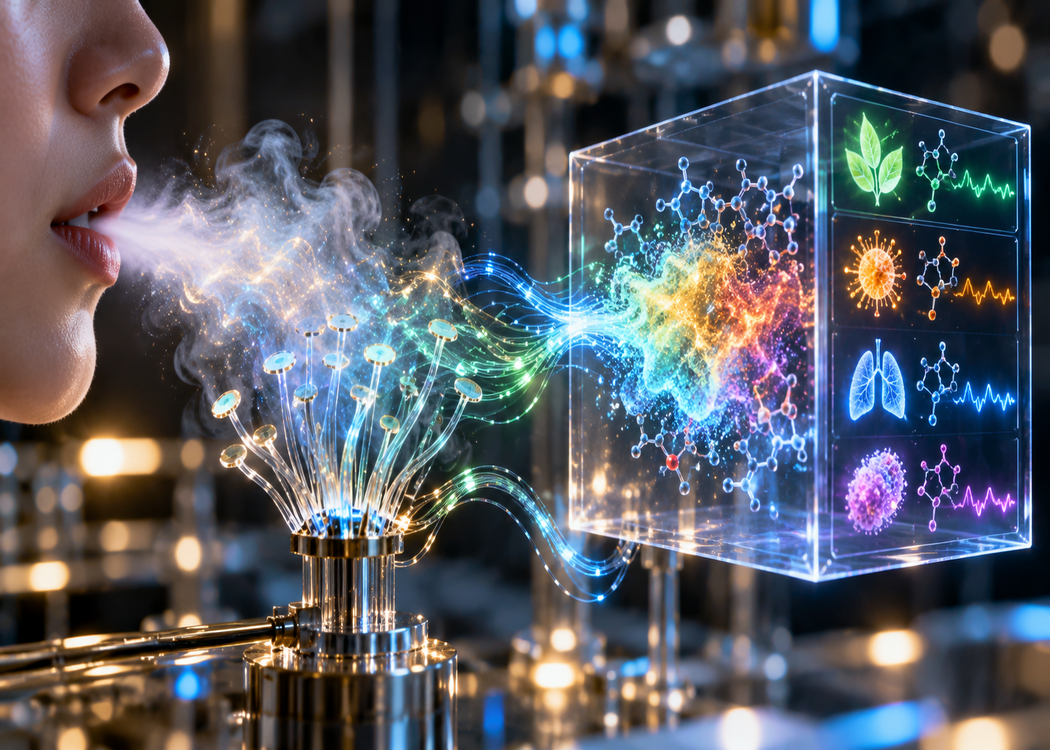
Scientists are investigating a new approach to medical screening that could make certain diagnostic tests faster, less invasive and easier to administer. By combining chemical sensors with artificial intelligence, researchers are developing systems capable of analyzing the complex mixture of substances released when a person exhales. These devices, often described as electronic noses or digital noses, attempt to identify patterns associated with particular diseases. The technology builds on the observation that human breath contains numerous volatile organic compounds (VOCs), some of which may change in concentration when biological processes are disrupted.
The underlying concept is relatively straightforward, although its implementation is technically challenging. Metabolic processes, inflammation, infections and other physiological changes can alter the chemical composition of exhaled breath. Sensitive instruments can detect some of these compounds, while machine-learning models analyze combinations of signals that may be too subtle or complex for traditional rule-based interpretation. Rather than relying on a single chemical marker, AI systems can potentially recognize patterns across multiple compounds, producing a chemical fingerprint associated with a particular condition.
A study published in January 2026 in npj Digital Medicine investigated a deep-learning approach to breath analysis for multi-cancer screening. The researchers explored how a hierarchical convolutional neural network could distinguish disease-related patterns in breath data, providing further evidence that computational analysis may improve the interpretation of complex chemical measurements. However, this study does not verify the original draft’s specific attribution to Microsoft Research or establish that a single Microsoft-developed device can reliably diagnose both lung cancer and kidney disease.
If successfully validated in large and diverse patient populations, AI-assisted breath testing could eventually support earlier disease detection, repeated monitoring and preliminary screening without blood collection or invasive procedures. The approach may be particularly useful in settings where conventional laboratory testing is expensive or difficult to access. Nevertheless, important obstacles remain, including differences in diet, medication, environmental exposure, sensor calibration and individual metabolism, all of which can affect breath chemistry. Researchers must also establish whether these systems provide sufficient sensitivity and specificity for real-world clinical decisions. The ultimate promise is a future in which a simple breath sample becomes a useful source of medical information—but the technology must demonstrate clinical reliability before it can replace established diagnostic methods.
Sources: