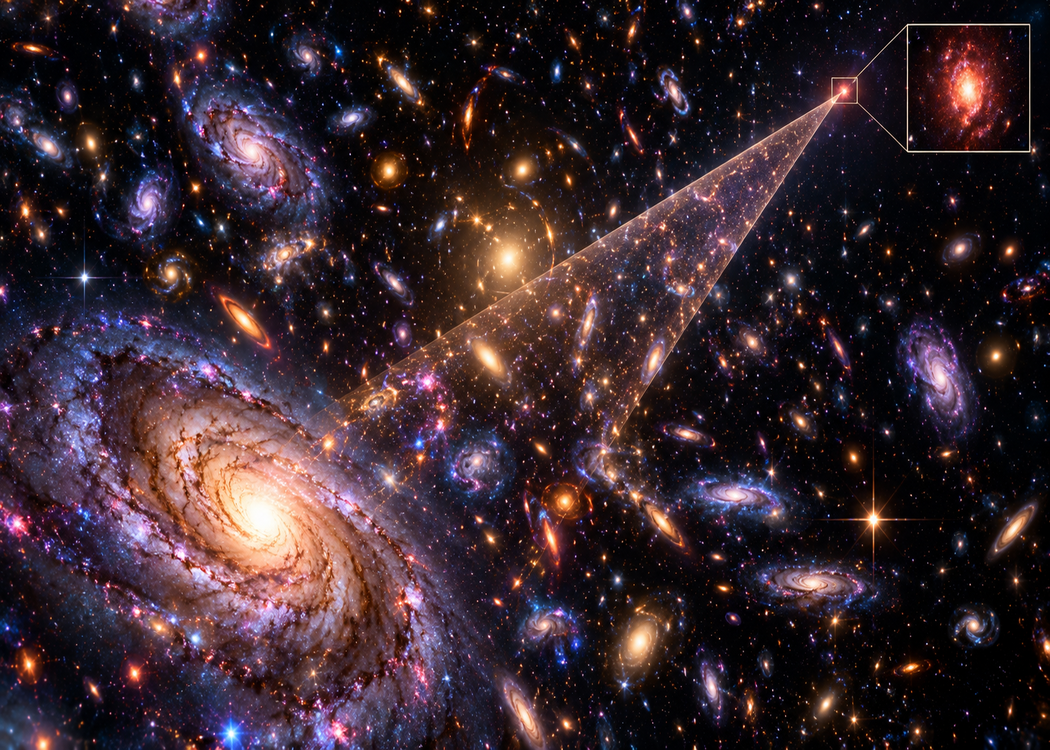
The James Webb Space Telescope is transforming humanity’s understanding of the early universe by detecting galaxies that existed only a few hundred million years after the Big Bang. One particularly important discovery was JADES-GS-z14-0, identified in observations announced in 2024. The galaxy existed less than 300 million years after the Big Bang, making it one of the most distant galaxies known at the time. Its discovery demonstrated Webb’s extraordinary ability to observe the earliest stages of galaxy formation.
The telescope achieves this by detecting extremely faint infrared light that has traveled across the expanding universe for billions of years. As space expands, light from distant galaxies is stretched toward longer wavelengths through a phenomenon known as cosmological redshift. By analyzing this light with Webb’s infrared instruments, astronomers can estimate how far away a galaxy is and determine the period in cosmic history when its light was emitted. Observing these galaxies is therefore a way of looking backward through time, revealing conditions that existed long before the Sun or Earth formed.
The observations are particularly exciting because some early galaxies appear brighter and more developed than scientists initially expected. Astronomers are investigating how stars formed so rapidly, how early galaxies accumulated material and how their radiation influenced the surrounding universe. In 2025, another galaxy, MoM-z14, was confirmed at a redshift of approximately 14.44, corresponding to about 280 million years after the Big Bang. This surpassed the earlier distance record held by JADES-GS-z14-0, illustrating how quickly Webb’s observations are extending the known cosmic frontier.
These discoveries do not mean that the Big Bang theory has been disproved. Instead, they provide new constraints on models describing how quickly stars and galaxies formed during the universe’s earliest stages. Researchers must now explain how some galaxies became sufficiently luminous and chemically developed in such a short period. Future observations could reveal even earlier structures and clarify the processes responsible for the first generations of stars. Every newly confirmed distant galaxy adds another chapter to the story of how the universe evolved from its earliest conditions into the complex cosmos observed today.
Sources: