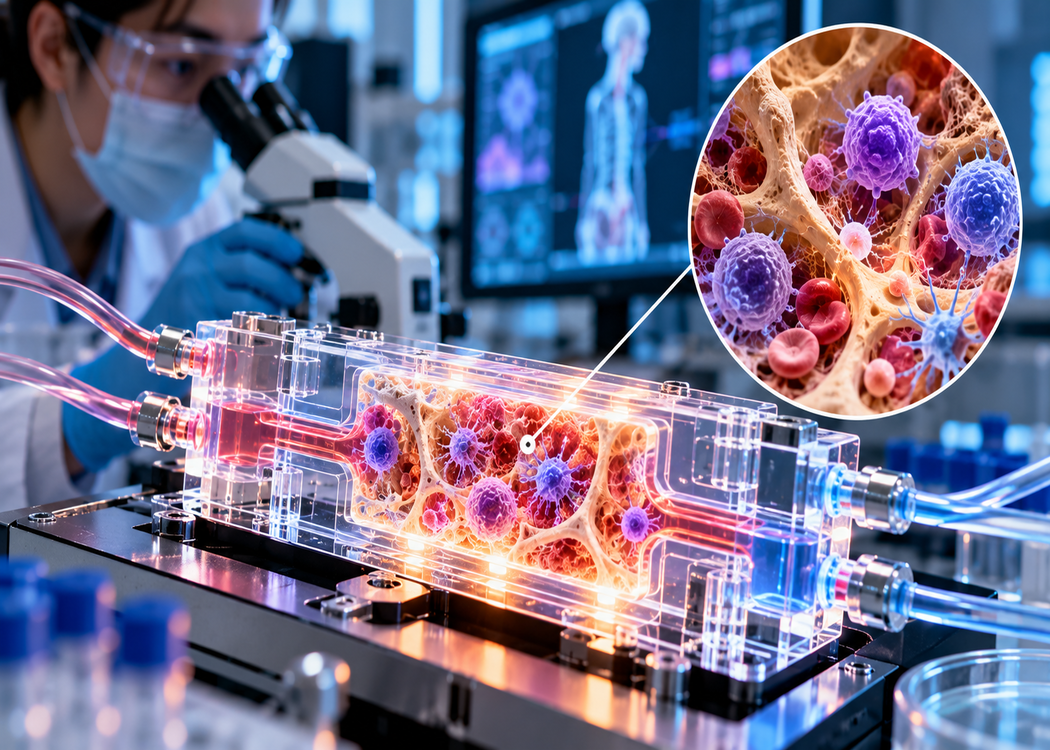
Scientists have developed a miniature laboratory system that reproduces important aspects of one of the human body’s most complex biological environments: bone marrow.
Bone marrow is the soft tissue inside certain bones where blood cells are produced. It provides an intricate environment supporting red blood cells, immune cells and specialized cells responsible for long-term antibody production.
Studying these processes directly inside living humans is difficult. Researchers therefore created a bone-marrow-on-a-chip, a small engineered system designed to recreate important features of the marrow environment under controlled laboratory conditions.
The device uses tiny channels and specially designed structures to allow human cells to grow and interact in ways that resemble some aspects of natural bone marrow.
NIH-funded researchers are particularly interested in using the system to investigate long-lived plasma cells. These specialized immune cells can survive for years and continuously produce antibodies after vaccination or infection.
Understanding how these cells survive could have implications for vaccines, immune disorders and treatments targeting abnormal plasma cells.
The technology belongs to a rapidly developing field known as organ-on-chip research. Scientists are creating miniature experimental models of organs and tissues including lungs, liver, intestine and blood vessels.
These systems cannot yet reproduce every function of a complete human organ. Their value comes from allowing researchers to observe specific biological processes in an environment that can be precisely controlled.
In the future, bone-marrow-on-chip technology could help researchers study immune responses, evaluate experimental medicines and understand why some treatments affect blood-cell production.
Together with organoids and AI-powered laboratories, it represents part of a broader movement toward experimental systems designed to reproduce human biology more accurately before treatments enter clinical trials.