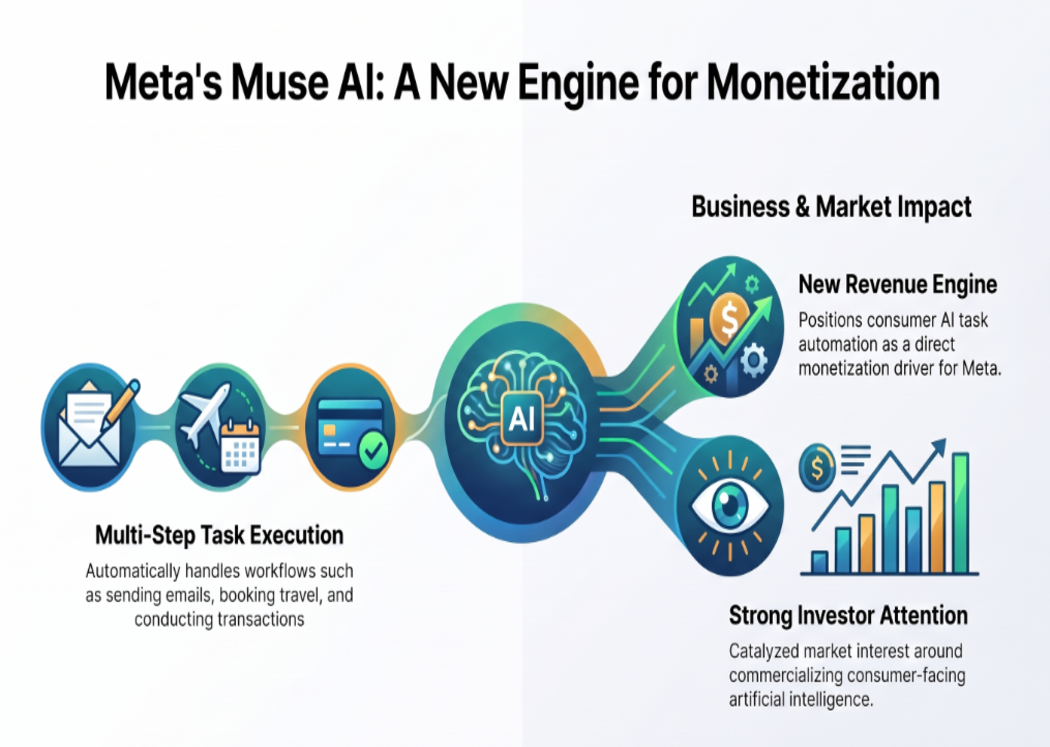
Paid subscriptions and a new push into small-business tools are opening commercial opportunities for Muse, though early enthusiasm has yet to establish its long-term earnings potential.
Meta is expanding its Muse artificial intelligence agent into small-business operations, adding a commercial dimension to a product already attracting attention from investors. The September 29 announcement introduces connections to workplace tools and business accounts, broadening Muse’s role beyond personal assistance.
Launched on September 8, Muse is designed to carry out tasks such as sending emails, arranging travel and completing online forms. Users can communicate with it through its app or WhatsApp, while the agent works across connected services. Meta says it can continue working after a user closes the app and seek approval when required.
For Meta, the commercial opportunity is to make that assistance valuable enough for people to pay for regularly. Muse offers a free version, with subscriptions priced at US$20 and US$100 per month for heavier use, according to Reuters. Those paid tiers provide a direct route to revenue as the company develops its consumer AI business.
Early adoption has strengthened investor interest. Reuters reported on September 22 that Muse recorded 2.8 million downloads during its first 12 days, citing Apptopia. Meta’s shares had risen more than 20% between the launch and the previous market close. These figures capture the initial response; downloads alone do not establish how many people will become regular or paying users.
The small-business expansion gives Muse another opportunity to demonstrate lasting value. Meta says the agent can connect to services including Canva, Shopify, Slack, Stripe and Intuit QuickBooks, alongside Facebook and Instagram business accounts. Suggested uses include reviewing sales performance, identifying unusual expenses, drafting campaigns and preparing responses to emails.
The business logic is straightforward: an assistant that consistently saves an owner time could become a recurring operating expense. That makes everyday usefulness, rather than launch curiosity, central to Muse’s revenue prospects. Whether businesses will pay depends on how reliably it performs and how much supervision its work requires.
Some analysts see substantial upside. Reuters reported that Jefferies outlined a scenario in which Muse reaches one billion users by the end of 2027 and converts at least 3% to paid access, generating US$10.8 billion in annualised revenue. That figure is a conditional analyst estimate, not revenue Meta has earned or company guidance.
Trust will also influence adoption. Delegating work to an agent requires users to decide how much access to grant over accounts and information. Meta says Muse operates in a dedicated virtual machine, provides an activity audit trail and lets people adjust connected-service permissions. For its small-business offering, the company says publishing, sending and spending require approval. These are company-described safeguards, rather than a guarantee that every task will proceed without errors.
Muse’s next commercial test is whether initial interest becomes a durable habit. Subscriptions create a way to charge for assistance, and business integrations expand the work that assistance can cover. Turning those opportunities into a significant revenue stream will require sustained use, paying customers and dependable execution.