Project Suncatcher’s first prototype will investigate whether Google’s AI hardware can operate reliably beyond Earth.
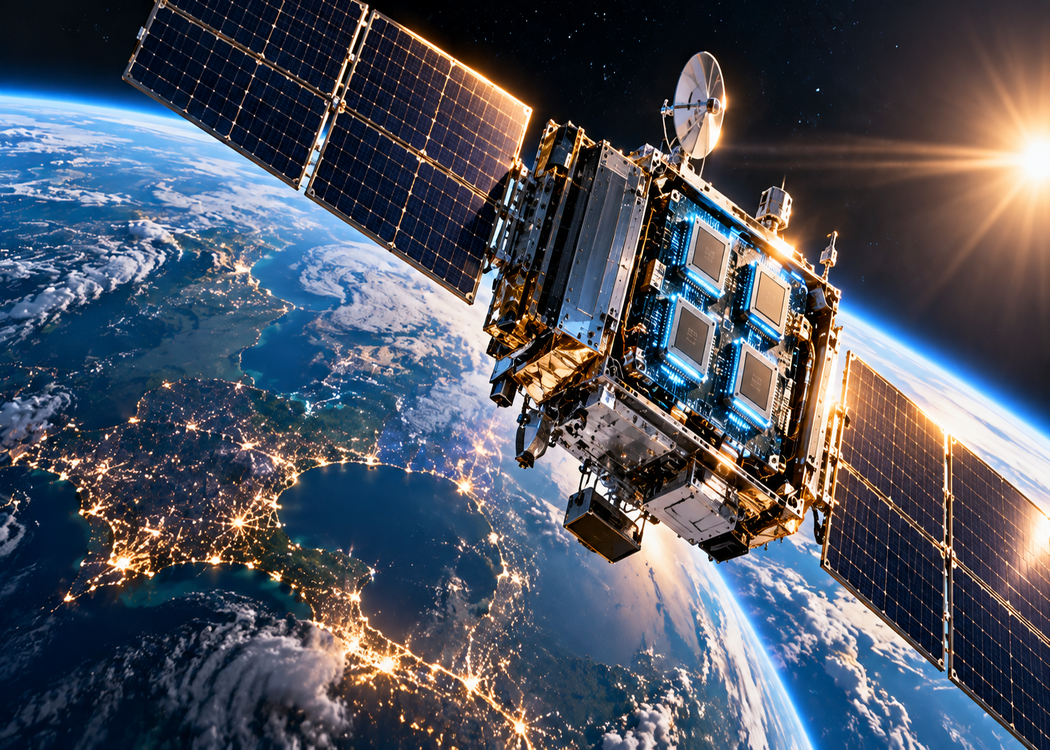
Google’s effort to explore artificial intelligence computing in space has reached its first orbital milestone. A prototype developed with Planet Labs launched on October 1 aboard SpaceX’s Transporter-18 rideshare mission from California, carrying hardware for Google’s Project Suncatcher research program. Planet confirmed the successful launch in an announcement that day.
The experiment investigates whether Google’s Tensor Processing Units, or TPUs, can function reliably in orbit. These specialized AI chips must contend with launch stresses, radiation and a thermal environment very different from a terrestrial data centre. Google describes the project as an early research effort to evaluate the foundations of future computing infrastructure in space.
The attraction is energy. Google’s proposed architecture would place solar-powered satellites in carefully selected orbits offering near-continuous sunlight. Its researchers estimate that, in suitable conditions, solar panels could generate up to eight times as much power as comparable panels on Earth. That potential depends on the orbit and comparison assumptions; it is not a universal advantage for every satellite.
Before that energy can support large-scale AI, engineers must establish whether the computing equipment can survive and perform consistently. Google conducted vibration tests to simulate launch conditions and exposed operating TPUs to proton beams to examine radiation effects. Those ground tests produced encouraging results, but the orbital mission will provide evidence that laboratory simulations cannot fully supply.
Cooling presents another challenge. A vacuum provides no surrounding air to carry heat away. Google is testing heat pipes and radiators to move heat from the chips and release it into space. The experiment will help determine how well that equipment works under actual orbital conditions.
Scaling up would also require fast connections between spacecraft. Large AI workloads often depend on many processors exchanging information rapidly. Google’s research therefore explores closely grouped satellites connected through high-bandwidth laser links, with precise positioning needed to maintain communication. A laboratory demonstration achieved 800 gigabits per second in each direction using one transceiver pair, although that does not establish equivalent performance in orbit.
A further mission planned for 2027 would place two satellites in orbit to test optical connections and distributed computing. That stage would build on the hardware lessons from the first prototype.
The economic case remains unsettled. Google’s analysis depends partly on substantial future reductions in launch costs, while thermal management, communication with Earth and long-term reliability remain engineering obstacles.
For now, the achievement is getting a research platform into space. Its value will come from measurements of chip reliability, cooling performance and operating conditions—evidence needed before an orbital AI data centre can become a practical proposition.
Sources: