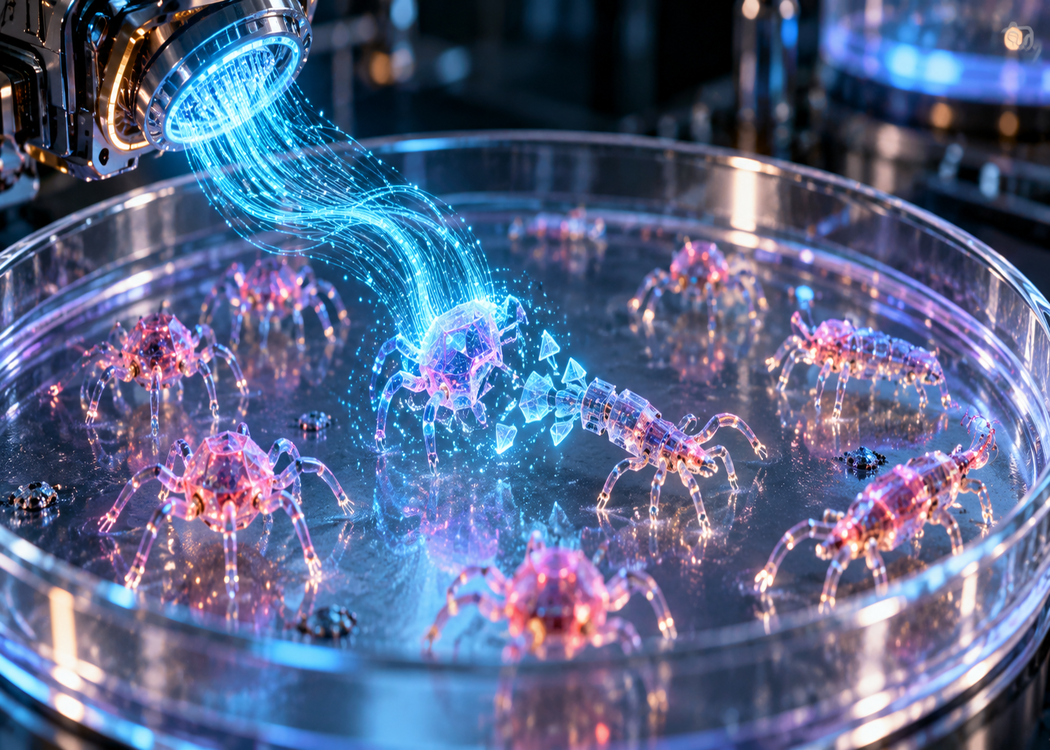
Researchers from Tufts University and the University of Vermont introduced an unusual technological achievement in 2020: tiny biological constructs assembled from living frog cells that could move and perform simple tasks. Known as xenobots, these millimeter-scale structures challenged the traditional distinction between living organisms and engineered machines. Unlike conventional robots built from metals, plastic and electronic components, xenobots were constructed from biological tissue, allowing them to move using the natural capabilities of living cells.
The researchers used cells derived from the African clawed frog, Xenopus laevis, and assembled them into carefully designed configurations. Computational methods helped identify body shapes capable of producing specific movement patterns, while laboratory techniques allowed researchers to build the resulting structures. Some xenobots could move through liquid environments, push small particles and recover from certain physical injuries. Their behavior emerged from the organization and interaction of living cells rather than from electronic processors or conventional programming instructions.
The research also raised important questions about the relationship between biological development and engineering. Cells normally cooperate to build tissues and organs according to complex developmental processes. Xenobots demonstrated that when cells are rearranged into unfamiliar configurations, they can collectively produce behaviors not normally associated with their original biological role. Later experiments explored additional forms of collective behavior, including the ability of certain xenobot configurations to gather loose cells into new structures under controlled laboratory conditions.
Potential future applications include studying tissue repair, biological self-organization and the design of biodegradable microscopic systems. Researchers have also discussed possible uses in environmental monitoring and targeted biomedical technologies, although these remain speculative. Xenobots are not miniature intelligent creatures capable of independently performing complex missions, nor are they controlled by continuous digital commands in the manner of ordinary robots. Nevertheless, they represent an important early demonstration of how living cells can become building blocks for engineered biological systems.
Sources: