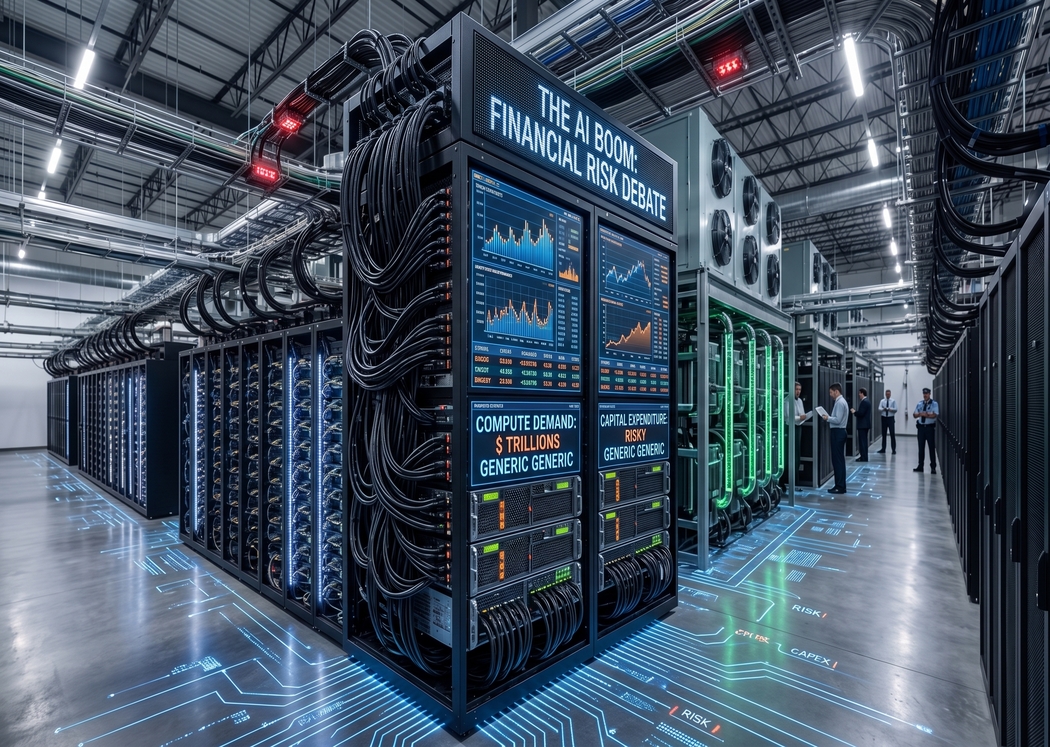
Artificial intelligence is producing one of the largest infrastructure investment cycles in modern economic history—and researchers are beginning to ask what happens if expected AI revenues fail to arrive quickly enough.
A September study discussed by Reuters estimated that the U.S. AI infrastructure build-out could require investment equivalent to roughly 3.6% of U.S. GDP annually through 2032, amounting to more than $10 trillion.
The money is going into far more than GPUs.
AI expansion requires enormous data centers, electricity generation, transmission infrastructure, cooling systems, networking equipment and real estate.
Initially, much of this investment could be financed directly by cash-rich technology companies. But as infrastructure requirements grow, financing is spreading into banks, private credit, property investors and increasingly complicated investment structures.
That is where financial-system questions emerge.
Columbia Business School researcher Stijn Van Nieuwerburgh has argued that the combination of leverage, uncertain future AI revenues and complex financing structures creates potential downside risks. His analysis does not say a crisis is inevitable; rather, it argues that the scale deserves closer monitoring.
The central problem is return on investment.
Building trillions of dollars of infrastructure makes economic sense only if AI ultimately produces sufficiently large and durable revenue streams.
This creates an unusual contradiction: companies may genuinely believe AI is transformative while investors can simultaneously question whether today’s infrastructure prices assume too much growth too quickly.
The AI boom is therefore becoming more than a technology story. It is increasingly an energy, real-estate and financial-system story as well.