The artificial-intelligence boom is changing what it means to design a processor. Nvidia’s Blackwell family is no longer best understood as simply another generation of graphics chips. It represents the company’s transition toward engineering entire AI computing systems.
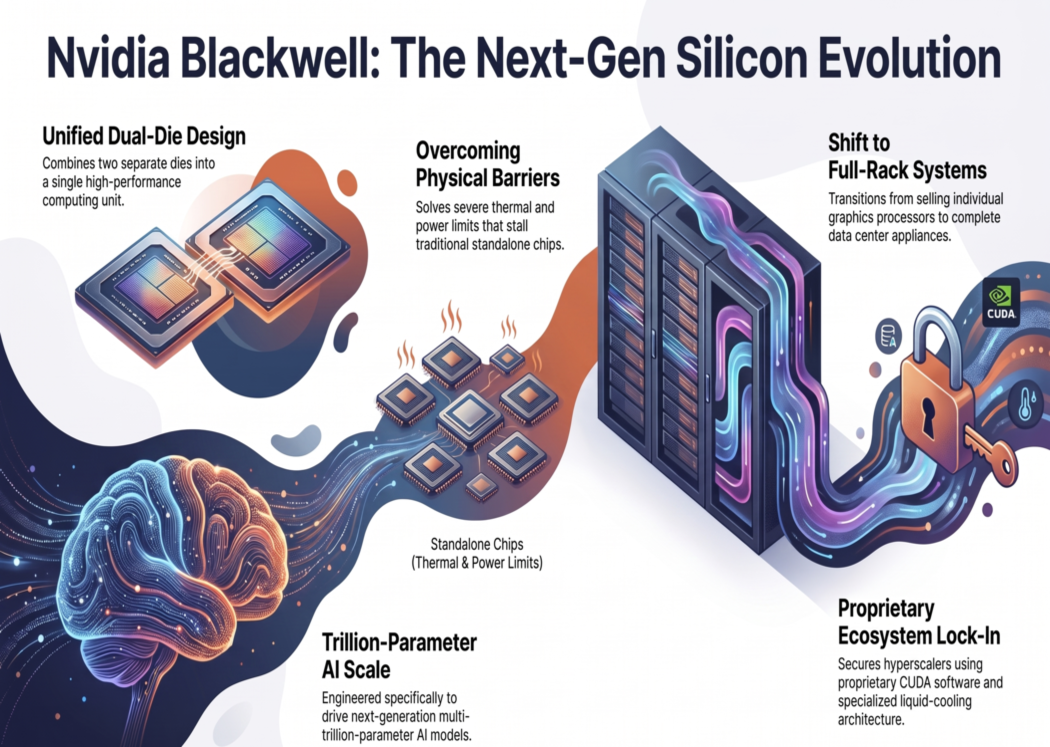
At the silicon level, Blackwell Ultra uses a dual-reticle design: two large dies are connected by Nvidia’s high-bandwidth die-to-die interface and operate as a single CUDA-programmed accelerator. The architecture is designed for extremely demanding AI workloads, particularly large-scale inference and reasoning.
But the larger strategic shift appears at rack scale. Nvidia’s GB300 NVL72 integrates 72 Blackwell Ultra GPUs and 36 Grace CPUs into one liquid-cooled system. Fifth-generation NVLink connects the GPUs so the rack can behave much more like one enormous computing resource than dozens of isolated servers. Nvidia says a full GB300 NVL72 rack can require up to 142 kW of power.
That illustrates the new challenge facing AI infrastructure. Performance improvements increasingly depend not only on transistor density, but also on memory bandwidth, networking, cooling and electricity.
Nvidia’s competitive advantage therefore extends beyond the GPU itself. CUDA software, NVLink networking, Grace CPUs, networking hardware and rack-scale systems create an increasingly integrated computing stack.
For customers, that integration can simplify the construction of enormous AI clusters. Strategically, however, it also makes Nvidia harder to replace because switching suppliers can mean replacing more than one component.
The semiconductor arms race is consequently becoming a systems-engineering race. The winners may not simply manufacture the fastest chip; they may control the architecture surrounding the entire AI factory.