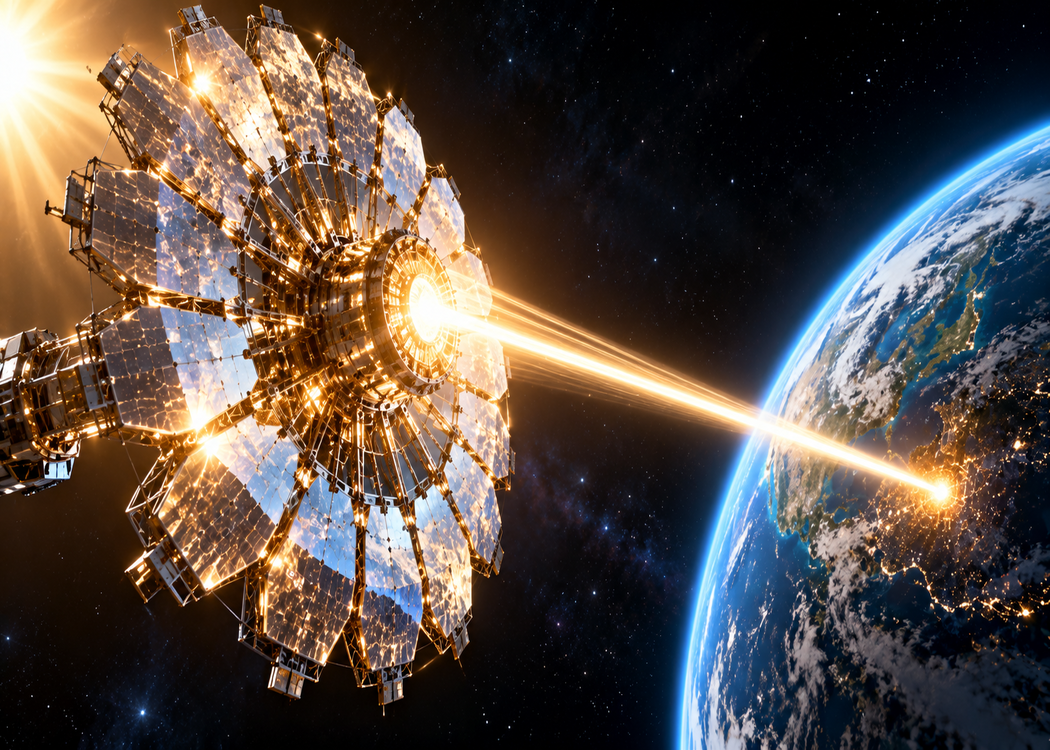
The idea of collecting solar energy in space and transmitting it wirelessly to Earth has moved beyond theoretical discussion. Researchers at the California Institute of Technology (Caltech) achieved a historic milestone in 2023 when their Space Solar Power Demonstrator successfully transmitted detectable power from orbit to a receiver on Earth. The experiment demonstrated that energy could be transmitted wirelessly across the enormous distance between a spacecraft and the planet’s surface, bringing scientists closer to a technology that has fascinated engineers for decades.
The breakthrough was made possible by an experimental system called MAPLE (Microwave Array for Power-transfer Low-orbit Experiment). Instead of physically connecting an energy source to a receiver, MAPLE used an array of lightweight microwave transmitters to direct electromagnetic energy toward a chosen location. In May 2023, researchers detected the transmitted signal on the roof of a Caltech laboratory in Pasadena. Although the amount of power received was extremely small, the successful detection demonstrated that the underlying transmission technology could operate in space.
Space-based solar power offers an intriguing advantage over conventional solar panels. Satellites operating in suitable orbits could collect sunlight without interference from clouds or the ordinary day-night cycle experienced by ground installations. A sufficiently advanced system might convert that energy into microwaves, transmit it toward a designated receiving station and convert it back into usable electricity. Such infrastructure could potentially supply energy to remote communities or support electricity networks when terrestrial renewable generation is limited. However, continuous delivery would depend on orbital architecture, receiving infrastructure and other engineering constraints.
Despite the achievement, major obstacles remain before orbital solar power can become commercially practical. Engineers must develop enormous but lightweight collecting structures, maintain accurate beam targeting, minimize transmission losses and launch equipment at economically viable costs. Safety and regulatory requirements would also need to be addressed. Caltech’s experiment did not demonstrate a functioning orbital power station, but it established an important proof of concept. The possibility of harvesting sunlight in space and delivering it to Earth is now supported by an actual orbital experiment rather than theory alone.
Sources: